
Air travel places different demands on a pet crate than everyday transport. A crate used around the home or during a short road trip may mainly need to provide a contained space. Air transportation adds more considerations, including limited space, repeated handling, ventilation, secure closure, and the need to remain suitable for the animal throughout the journey.
For that reason, crate design is not simply a matter of making a box large enough for a pet. The dimensions, openings, door, base, internal fittings, and outer structure all have a role. A change in one area can also affect another. For example, increasing the internal space may change the position of ventilation openings, while adding fittings inside can reduce the usable area available to the animal.
Airline requirements also vary according to the type of transportation and the carrier involved. A crate that appears suitable for one travel arrangement may require additional checks for another. Paying attention to these details during the design stage can make the relationship between the animal, the container, and the transportation process clearer.
Size is one of the first design considerations because the animal needs enough room to remain in a natural position. A crate should not be treated simply as a container that holds the animal in place. Its internal dimensions influence movement, posture, bedding, ventilation, and the placement of other components.
When determining the appropriate size, the animal's actual body shape matters. A long-bodied pet may need more internal length, while a taller animal may require additional vertical clearance. Body weight alone does not describe these differences.
The internal space should allow the animal to:
The external dimensions matter as well. A crate may have enough internal room but still be unsuitable for a particular transportation arrangement because of its overall footprint.
This is why sizing should be considered from both sides. The interior needs to accommodate the animal, while the exterior needs to work within the intended handling and transport environment.
Another point is that bedding and internal accessories take up usable space. A design that appears sufficiently large before these items are installed may feel different once the interior is prepared for travel.
For an Airline Pet Crate, sizing therefore involves more than selecting a nominal size category. It requires attention to the animal's proportions, internal layout, external dimensions, and intended method of transportation.
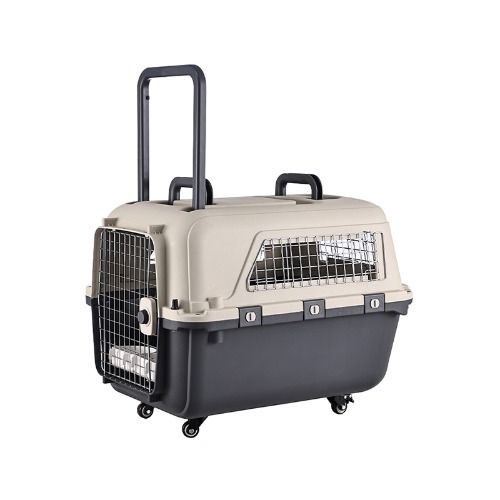
Ventilation is closely connected with the shape and layout of the crate. An enclosed container needs openings that allow air to move through the interior while maintaining an appropriate level of containment.
The location of ventilation openings matters. Openings placed along different sides can influence how air enters and leaves the crate. They also affect visibility, protection, and the available wall area for structural components.
The design needs to balance several considerations:
Ventilation should also be considered together with the crate's size. A larger interior does not automatically mean better air movement. The relationship between internal volume, opening placement, and surrounding surfaces is part of the design process.
For soft-sided carriers used in cabin transportation, another consideration is possible compression when the carrier is placed in a restricted space. A side panel that becomes pressed against another surface can reduce the effective opening area.
Rigid designs have different considerations. Their walls retain their shape, but the location and form of ventilation openings still need to work with the structure.
Good ventilation design is therefore not simply about adding more openings. It is about placing suitable openings where they can remain functional without creating problems for containment or structural integrity.
The overall structure determines how the crate holds its shape during transportation and handling. Unlike a container intended for stationary use, a travel crate may be lifted, moved, placed down, and transferred several times.
The main structural areas can be considered together:
| Area | Design consideration |
|---|---|
| Base | Provides a stable surface and supports the animal |
| Side walls | Enclose the interior while accommodating ventilation |
| Top section | Helps maintain the overall shape of the crate |
| Door area | Provides access while maintaining closure |
| Connections | Join major sections and support repeated handling |
| Interior surfaces | Should avoid unnecessary projections or rough areas |
The base deserves particular attention because it is directly connected with the animal's footing and with the containment of bedding or moisture. A stable base can also help prevent unwanted movement when the crate is being carried.
The side walls need to balance enclosure and airflow. Their shape can influence where openings, handles, and connection points are positioned.
Connections between sections are another consideration. If the crate consists of multiple parts, those parts need to remain properly aligned after assembly. Loose or poorly fitted sections can affect the overall condition of the container.
The structure also needs to account for cleaning. Interior surfaces that are difficult to access can make routine preparation less convenient, especially when the crate is used repeatedly.
Rather than treating each component separately, the design needs to consider how the parts work together. A change to the door frame, for example, can affect the available wall area for ventilation or the placement of a fastening point.
The door is one of the areas that receives frequent attention because it provides the main point of access to the interior. It needs to open when the animal is being placed inside, while remaining closed during transportation.
A practical door design needs to consider both closure and handling. A complicated mechanism may create difficulties during routine preparation, while a poorly fitted door can affect the enclosure.
The relationship between the door and surrounding frame is important. The door should sit correctly within the opening, and the fastening arrangement should keep the two parts aligned.
The design should also avoid unnecessary gaps around the door. Openings need to be considered not only from the perspective of access, but also in relation to containment and ventilation.
Repeated use can place additional demands on hinges, fasteners, and surrounding materials. These parts may be opened and closed during preparation, inspection, cleaning, and later use.
A suitable design therefore treats the door as part of the entire structural system rather than as an independent accessory. Its position, opening direction, frame, and fastening arrangement should correspond with the rest of the crate.
The interior should remain functional without becoming crowded. Food and water containers, bedding, and other permitted items can change the usable space and should therefore be considered during the design stage.
Water containers are particularly important because they need to remain accessible while avoiding unnecessary movement. Their position should not interfere with the animal's ability to stand, turn, or lie down.
Bedding also has a practical role. It can provide a more familiar surface for the animal, but excessive material may shift during handling or occupy space needed for movement.
Internal surfaces require attention as well. Protruding parts, exposed fasteners, or rough edges may create unnecessary contact points.
A simple internal layout can make preparation easier. It can also make it easier to inspect the condition of the crate before transportation.
The following relationship is useful when considering the interior:
Available space → animal movement → accessory placement → ventilation → cleaning
Changing one element can influence the others. For example, moving a water container may affect the area available for movement, while additional bedding can alter the usable floor surface.
This is one reason an Airline Pet Crate should be considered as a complete system rather than a collection of separate parts.
Air transportation involves more than the time spent inside an aircraft. Before and after the flight, the crate may be moved between different locations and handled by different people.
This affects how the container should be constructed. Handles, connection points, the base, and external surfaces all need to work with normal handling procedures.
The crate may be lifted from different positions. It may also be placed on a floor or another surface, moved through an airport area, or transferred between transportation stages. These actions make structural stability an important consideration.
External design can also affect handling. A shape with clearly accessible lifting areas may be easier to move than one where suitable grip points are difficult to locate.
The following areas are worth considering together:
| Handling area | Related design concern |
|---|---|
| Lifting | Accessible and appropriately positioned grip areas |
| Placement | Stable contact with the supporting surface |
| Transfer | Structure that remains assembled during movement |
| Inspection | Components that can be checked without unnecessary disassembly |
| Cleaning | Surfaces that can be reached and maintained |
| Storage | Shape that can be positioned without damaging key components |
Wheels, when present on a crate design, require additional consideration because they can change how the container behaves during movement and placement. Their use should correspond with the transportation arrangement and applicable requirements.
Handling also explains why a crate designed only around the animal's comfort may not be sufficient. The container needs to work for the people moving it as well.
Airline transportation does not operate under a single set of practical conditions. Different carriers can establish their own requirements in addition to broader transportation guidance.
The differences may relate to cabin travel, cargo transportation, aircraft space, pet size, crate dimensions, or preparation procedures. Because of this, selecting a crate should involve checking the requirements that apply to the intended journey.
A useful distinction is between general design suitability and carrier acceptance.
A crate may have appropriate structural characteristics and still require additional confirmation before travel. The airline may have rules concerning dimensions, construction, ventilation, door design, or the type of animals accepted for transportation.
The intended travel arrangement can also change the requirements.
For example, cabin transportation can involve space beneath a passenger seat, while other forms of transportation may allow a different crate configuration. These environments create different practical limitations.
This means that a manufacturer or user should avoid assuming that one design automatically fits every airline or every route.
Before travel, it is useful to confirm:
Checking these points early can prevent a mismatch between the container and the transportation arrangement.
A final inspection brings the different design considerations together. It does not need to be complicated. The purpose is to make sure that the crate remains in suitable condition and that its configuration matches the planned transportation.
Start with the exterior. Look at the walls, base, door frame, handles, and connection areas. Any visible damage, loose component, or poorly fitted section deserves attention before the crate is used.
Then inspect the interior. The animal should have appropriate room to move, while bedding and permitted accessories should remain in their intended positions.
Ventilation openings should be unobstructed. The door should close properly, and the fastening arrangement should remain in the expected position.
A simple preparation sequence can include:
The last step is particularly important because transportation rules can change according to the carrier and travel arrangement. General information about an Airline Pet Crate should not replace checking the conditions set by the airline handling the journey.
Careful design connects the needs of the animal with the practical demands of air transportation. Size affects movement, ventilation affects the internal environment, structure affects handling, and the door and fittings affect containment. Airline requirements then determine whether the selected configuration is appropriate for a particular trip.
When these elements are considered together, the purpose of the crate becomes clearer: it needs to provide a contained, functional space while also working within the conditions created by air transportation.



 English
 русский
 عربى
عربى