
A pet carrier can look fairly simple from the outside. There is a shell, a door, a handle, and a series of openings. Yet, when the carrier is used regularly, these parts begin to raise practical questions. Where should the openings be positioned? What happens when one side is close to a seat? Is the door easy to check after repeated use?
The design of a hard-shell carrier is closely connected to these everyday situations. Unlike a soft bag, a plastic shell keeps its general shape and has fixed areas where openings can be placed. The shape of the body, the location of the door, and the arrangement of the ventilation slots all influence how the product is handled.
For people involved in pet product design, manufacturing, or purchasing, the appearance of a carrier is only one part of the discussion. Small details, such as the distance between openings and the surrounding shell, may affect cleaning, inspection, and placement. Looking at these details provides a practical way to examine how a Ventilated Pet Carrier is designed for regular transportation.
Look at a typical hard-shell carrier and the openings are not necessarily concentrated in one area. Some are positioned on the top, while others run along the sides. This arrangement is visible in the pictured carrier, where elongated slots follow the curved upper and side sections of the plastic body.
The reason for this layout is related to the shape of the carrier and the way it is used. A carrier may be held upright during carrying and placed in a different position once the journey begins. Its sides may face another object, while the upper surface remains exposed.
That makes the location of an opening worth examining rather than treating all ventilation slots as interchangeable. A side opening and a top opening can face different surroundings, depending on how the carrier is placed.
For example, a side panel positioned close to a seat may have less open space around it than the upper shell. This does not automatically establish a particular airflow result, but it does show why the arrangement of openings deserves attention.
When reviewing the layout, several questions can be considered:
The design of a Ventilated Pet Carrier involves more than the number of slots visible on the outside. Their position, shape, and relationship with the rest of the shell all contribute to how the carrier is used.
Long, narrow ventilation slots give a hard-shell carrier a recognizable appearance, but they also create surfaces that need regular attention. Pet hair and dust can collect around openings, particularly when the carrier is used frequently or stored in an area where loose material gathers.
Cleaning a broad, flat surface is not quite the same as cleaning a series of narrow slots. The edges may require more care, and the choice of cleaning tool can influence how easily the surrounding area is reached. The exact process depends on the material and the instructions supplied with the product.
The shape of the opening is only one consideration. Its position on the shell matters too. Openings on a curved surface may be approached differently from those on a relatively flat section. A user may need to change the angle of a cloth or brush to reach the edges.
A few practical points are worth considering during maintenance:
| Opening feature | Practical maintenance consideration |
| Narrow slots | Edges and recessed areas may need closer attention |
| Curved shell placement | The surface shape can affect cleaning access |
| Several opening sections | Different areas need to be checked separately |
| Fixed openings | Cleaning takes place directly on the carrier body |
There is no need to assume that every opening requires the same cleaning treatment. The shape and construction of the product should guide the process. A carrier with multiple ventilation areas may benefit from a consistent inspection routine, particularly around the edges where hair and dust are easier to overlook.
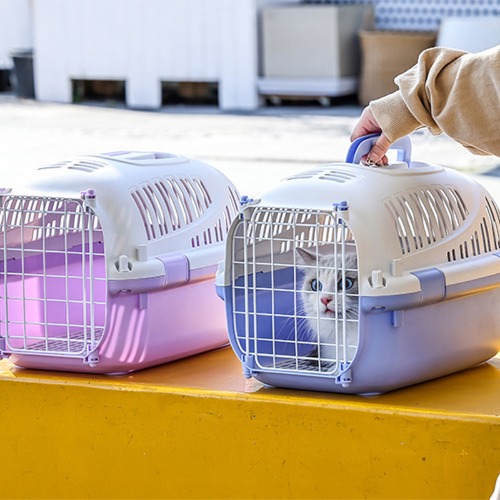
The front door of a hard-shell carrier is easy to confuse with the other openings when looking at the product as a whole. Both create openings in the carrier body, but they are not designed for the same purpose.
In the pictured product, the front door consists of a metal grid within a frame. It is a movable component used for entry and exit. The ventilation slots on the plastic shell, meanwhile, are fixed openings integrated into the body.
This distinction becomes useful when inspecting the carrier. The door has parts that move and close, while the shell openings need to be checked as part of the fixed structure. Combining these areas into one general description can make it harder to identify specific maintenance concerns.
The door and ventilation slots can be reviewed separately:
The design of the door also affects how a pet enters the carrier. Its position and size influence access to the interior, while the fixed shell determines where the ventilation openings can be placed.
When discussing a hard-shell Ventilated Pet Carrier, it is more useful to describe these features according to their individual roles. The door is associated with access and closure. The side and top openings belong to the shell's ventilation arrangement. Both are relevant to the product, but they should not be described as if they perform the same function.
A carrier rarely stays in an empty space throughout transportation. It may be set beside a seat, near a wall, or next to other belongings. These surroundings can change the amount of open space available around the shell.
The issue is particularly noticeable when the side of the carrier faces another surface. If a bag or seat is positioned close to the ventilation openings, part of the opening area may become covered. The effect depends on the object's position, the carrier's orientation, and the surrounding space.
This is why placement deserves more attention than simply deciding where the carrier can physically fit. A position that looks convenient may still require a closer look at the openings on the shell.
Consider a few common situations:
These situations are not identical, and their effect cannot be determined from the carrier's appearance alone. Still, they illustrate why users should consider the surrounding space when positioning the product.
The placement of a Ventilated Pet Carrier should also account for stability and the applicable transportation instructions. A carrier that is suitably positioned for one environment may need a different arrangement elsewhere. Ventilation openings should be considered alongside the carrier's overall placement, rather than treated as an independent feature.
The carrying handle is a small part of the product, but it plays a direct role when the carrier is moved. In the pictured design, the handle sits on the upper shell and allows the user to lift the box.
The position of the handle affects how the carrier is gripped and moved from one place to another. Once it is set down, however, the carrier's final orientation depends on the available space and the way it is positioned.
This creates a connection between handling and placement. A user may lift the carrier with the handle, then turn or reposition it before setting it down. During that process, the sides and top can face different surroundings.
The handle itself should be inspected separately from the ventilation openings. Relevant considerations include its attachment, visible wear, and whether it can be used as intended. Nearby objects should also be considered when the carrier is lifted or moved.
For product designers, the handle's location is one part of the overall shell layout. It needs to be considered alongside the door, opening arrangement, and other components without assuming that its position alone determines the suitability of the carrier for a particular journey.
The shell of a hard carrier is made up of connected sections rather than one uninterrupted piece. In the pictured design, the upper and lower plastic sections meet around the body, with fastening and locking elements positioned near the edges.
These connections are worth checking because the carrier is opened, closed, lifted, and moved over time. Repeated handling may create visible changes in the condition of the components, even when the outer shell still looks relatively clean.
The joints can be examined as part of routine maintenance. Attention may be directed toward the meeting edges of the shell, the locking elements, and the areas surrounding the front door.
A useful inspection can include:
The exact inspection method depends on how the carrier is constructed. Some products use different fastening arrangements, so the same procedure should not automatically be applied to every design.
The connection between shell sections is also relevant during cleaning and storage. Dirt may collect around edges, while unsuitable storage conditions may place pressure on certain components. Paying attention to these areas helps users identify visible maintenance concerns before the carrier is used again.
A carrier check before transportation does not need to focus on the ventilation slots alone. The openings form part of the shell, and their condition should be considered alongside the door, handle, and connecting components.
For the slots themselves, a user can look for visible dirt, accumulated hair, or objects that cover part of an opening. The surrounding plastic can be examined for cracks or other visible damage. Cleaning should follow the product's instructions and the materials involved.
A practical check may move through the carrier in a consistent order. The ventilation areas can be reviewed first, followed by the door, shell connections, and handle. The final placement area should also be considered before the carrier is moved.
| Inspection area | What to look for |
| Ventilation slots | Visible blockage, dirt, or damage |
| Front door | Closure, grid condition, and connection |
| Shell joints | Visible cracks, loose parts, or misalignment |
| Carrying handle | Condition of the handle and attachment |
| Placement area | Potential obstruction from nearby objects |
The purpose of this check is to identify visible issues, not to make unsupported claims about the carrier's performance. A clear opening does not by itself establish that the surrounding environment is appropriate for a pet.
For a Ventilated Pet Carrier, routine inspection provides a practical way to pay attention to the product's condition before use. Any concerns that cannot be resolved through ordinary cleaning or inspection should be handled according to the manufacturer's guidance.
When reviewing a hard-shell carrier, it helps to look at the product as a combination of connected features. The ventilation slots are an important part of the outer shell, but they sit alongside the door, handle, joints, and other structural details.
A review can begin with the opening arrangement. From there, it can move to the way the shell is assembled and how the carrier is handled during transportation. Cleaning and inspection also provide useful perspectives because they involve direct interaction with the product.
Different features raise different questions:
| Feature | Area of consideration |
| Ventilation slots | Position, shape, and access for cleaning |
| Hard-shell body | Opening layout and surface condition |
| Metal door | Operation, connection, and visible wear |
| Carrying handle | Handling and attachment |
| Shell joints | Connection areas and maintenance |
| Outer surfaces | Cleaning access and visible condition |
The goal is not to treat one component as responsible for every aspect of the carrier. The openings relate to the shell design, while the door and handle have their own functions. Their relationship becomes relevant when the carrier is moved, placed, cleaned, or inspected.
A hard-shell Ventilated Pet Carrier can therefore be examined through a range of practical design questions. The position of the slots, the shape of the body, the arrangement of the door, and the condition of the connecting parts all provide different points of reference.
This approach keeps the discussion focused on observable product features and ordinary use. It also gives manufacturers, purchasers, and other industry readers a clearer way to discuss ventilation design without relying on broad performance claims that require separate testing or verification.



 English
 русский
 عربى
