
Mealtime does not always have to be a simple process of placing food in a bowl and waiting for a pet to finish. For many dogs, the time spent eating can also involve searching, sniffing, moving, and making choices. A feeding product that introduces these activities can change the pace and character of an ordinary meal without turning feeding into a complicated routine.
A Slow Feeder Toy can combine food access with small tasks that encourage a dog to look for food and work out how to reach it. Instead of receiving every bite immediately, the pet may need to follow a scent, move around different sections, or try another approach when food is not immediately visible.
This type of feeding activity connects several everyday behaviors. Eating becomes slower, but the change is not limited to speed. Sniffing can become part of the process, simple food puzzles can create mental engagement, and movement can give an active pet something appropriate to focus on. For owners, the same routine can also become an opportunity to observe how a dog responds to different levels of challenge.
A conventional meal usually has a clear beginning and end. Food is placed in an accessible container, and the dog can reach it with little effort. A slower feeding design changes that sequence by creating small steps between the food and the pet.
The purpose is not simply to make eating inconvenient. The feeding process can give the dog something to do while obtaining each portion. Looking for a piece of food, changing position, or working around an obstacle adds activity to an otherwise straightforward meal.
This difference can be useful when considering how pets spend their time at home. Eating is already part of the daily routine, so adding a small amount of interaction does not necessarily require a separate play session.
| Conventional feeding | Interactive feeding |
|---|---|
| Food is readily visible | Food may be partly hidden |
| Access requires little effort | Access involves simple actions |
| Eating can be relatively brief | Food access can take longer |
| Limited interaction with the feeder | Sniffing and searching become part of feeding |
A well-designed feeding activity should still allow the pet to participate comfortably. If the food is excessively difficult to reach, the experience can become frustrating rather than engaging. The useful balance is to make the dog work for some food without making the meal feel inaccessible.
Dogs rely heavily on their sense of smell when interacting with their surroundings. Food-search activities make use of that natural behavior by placing food in locations that require closer investigation.
Instead of seeing the entire meal at once, a dog may move its nose across different areas and pause when it detects a familiar scent. The process can encourage slower movement and repeated searching. Even when the food itself is simple, the way it is presented can change the activity surrounding the meal.
Different hiding areas can also create different experiences. Food placed in an open section may be easy to locate, while food positioned farther inside a recessed area may require more investigation. This gives owners a way to adjust the activity according to the pet's familiarity with the product.
Scent-based feeding can involve several natural actions:
The value lies in the process rather than simply in making food harder to obtain. A feeding activity that encourages natural searching can give a dog a clear task while keeping food as part of the familiar daily routine.
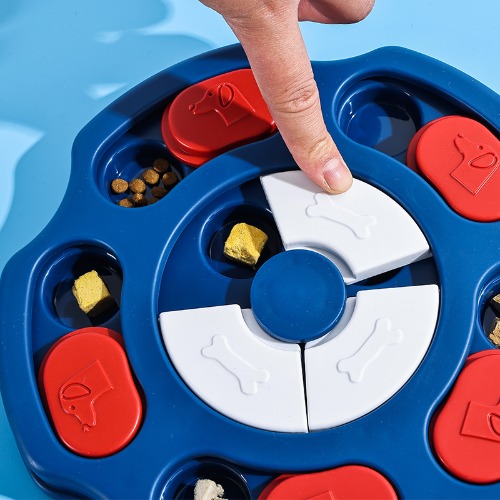
A food puzzle does not need to resemble a complicated game. Even a few changes in food placement can create a simple problem for a pet to solve. The dog may notice that food is visible but not immediately reachable, then try a different movement to access it.
Some designs use openings, recessed areas, movable sections, or different paths between the pet and its food. These features can encourage trial and adjustment. If one approach does not work, the dog may change its position or try another action.
The important distinction is between access and discovery. With direct feeding, the pet already knows where the food is and how to reach it. With puzzle-based feeding, the pet may need to determine both where the food is located and how it can be reached.
For a new user, a simple arrangement is generally easier to approach. Once the dog becomes familiar with the activity, more varied food placement can provide a different level of engagement.
This progression can be viewed in a practical way:
See → Smell → Search → Try → Reach → Eat
The sequence turns an ordinary feeding moment into a series of small decisions. It does not require the pet to complete a complicated task. The interaction comes from making food access less automatic.
Mental activity during feeding comes from having something to respond to. A dog may notice a scent, inspect a section, attempt to reach a piece of food, and then repeat the process. Each action gives the pet a reason to remain involved rather than simply consuming the meal.
This is particularly relevant for dogs that enjoy investigating objects and surroundings. A feeding activity can provide a controlled setting for this kind of behavior.
The mental side of the experience can involve:
These activities are simple, but they can make the meal less passive. The goal is not to measure intelligence or turn feeding into a test. Instead, the feeding environment gives the dog opportunities to make small choices.
A Slow Feeder Toy can therefore serve two connected purposes. It changes the pace at which food is obtained while also creating opportunities for searching and problem solving. The two functions work together rather than existing as separate features.
Food is usually associated with eating, while play is associated with movement. Interactive feeding brings some of these activities closer together.
A dog that spends time sniffing, walking around a feeding surface, repositioning its body, or working with accessible food is doing more than simply standing in one place and eating. The amount of movement will depend on the individual dog and the way the feeding activity is arranged, but the process can provide another outlet for everyday energy.
This does not make interactive feeding a replacement for normal exercise. Walking, play, and other forms of physical activity remain separate parts of a pet's routine. Instead, food-based activities can add movement to a moment that would otherwise involve little activity.
For owners managing an active dog indoors, this distinction matters. A feeding activity can provide something appropriate to investigate after a period of rest or during ordinary time at home.
| Type of activity | Main form of engagement |
|---|---|
| Direct feeding | Eating |
| Sniffing for food | Searching |
| Food puzzles | Trying and adjusting |
| Interactive feeding | Eating, searching, and movement |
The combination can make mealtime feel less repetitive. Rather than separating every form of activity into a different part of the day, some mental and physical engagement can occur naturally around food.
A pet's behavior at home can be influenced by how much activity and interaction its daily routine provides. When there is little to investigate or do, some dogs may look for their own sources of stimulation.
Interactive feeding provides a defined activity with a clear purpose: locate the food and obtain it. This can give a dog something appropriate to focus on during part of the day.
For pets that become restless during quiet periods, the process of sniffing and searching can create a temporary change in routine. The dog has a task to complete instead of simply waiting for the next source of attention.
It is important not to treat a feeding toy as a solution for every form of anxious or unsettled behavior. A pet's behavior can have different causes, and feeding activities cannot address all of them. However, providing regular opportunities for engagement can form one useful part of a broader home routine.
The way the product is introduced also matters. A dog that is unfamiliar with interactive feeding may need an easy starting point. If the pet cannot access food after repeated attempts, the activity may create frustration instead of calm engagement.
Destructive behavior at home can sometimes appear when a dog has limited opportunities to use its energy or investigate its surroundings. Chewing household objects, moving items, or repeatedly seeking attention can become attractive simply because these actions provide stimulation.
A food-based activity offers another target for that curiosity. Instead of searching through household objects, the dog can investigate a designated feeding area and work toward food.
The connection is not automatic. Giving a pet an interactive feeder does not guarantee that unwanted behavior will disappear. The surrounding routine still matters, including appropriate exercise, interaction, rest, and access to suitable objects for chewing or play.
What the feeding activity can provide is a structured alternative.
Boredom → Search for stimulation → Appropriate feeding activity → Focused engagement
This is particularly relevant for indoor routines. When a dog has something specific to investigate, some of its curiosity can be directed toward an intended activity rather than toward furniture or household items.
The design should also be appropriate for the individual pet. If food is completely inaccessible, the dog may abandon the activity. If every piece is immediately available, there may be little reason to investigate. A moderate level of challenge gives the feeding process a clear purpose without making it unnecessarily difficult.
Interactive feeding does not have to mean that the pet is left alone with a product. Owners can remain involved by preparing the food, observing how the dog approaches the activity, and changing the arrangement when necessary.
Observation is particularly useful when introducing a new feeding routine. Some dogs immediately begin sniffing and searching, while others may need time to understand that food can be found in different areas.
Owners can pay attention to simple signs:
These observations can guide how food is placed and how challenging the activity should be. The goal is not to make every meal increasingly difficult. A familiar and manageable routine can be just as useful as a challenging one.
There is also a social element. Preparing an interactive meal, watching the dog search, and responding to its behavior can create a shared daily moment. Feeding remains the primary purpose, but the surrounding interaction becomes part of the experience.
In this sense, a Slow Feeder Toy can sit between feeding and play. It does not need to replace a food bowl, a walk, or a separate play session. Its role can simply be to give an ordinary meal another layer of activity: food to locate, scents to follow, small problems to solve, and a reason to stay engaged.



 English
 русский
 عربى
عربى