
Getting a dog into a vehicle can become less straightforward when jumping is no longer comfortable or when the vehicle has a high entry point. A ramp creates a walking route between the ground and the vehicle, but its usefulness depends on more than the strength of its frame. Length, width, surface grip, support, connection points, and storage all affect how a dog approaches and crosses the ramp.
A Heavy-duty Pet Ramp is often considered for larger dogs or regular vehicle use, yet the practical question is whether its design matches the setting. The vehicle determines the starting conditions, the ramp shape influences the climb, and the surface and support structure affect each step. The dog's size, movement, age, and confidence also have a role.
| Design factor | Main question to consider | Related use condition |
|---|---|---|
| Ramp length | How steep is the walking path? | Vehicle entry height |
| Ramp width | Does the dog have enough walking space? | Dog body size |
| Load capacity | Can the structure handle the intended use? | Dog weight and movement |
| Support points | Does the ramp remain settled? | Vehicle and ground surface |
| Surface texture | Does the dog have sufficient grip? | Dry or damp conditions |
| Folding design | Can it be stored and handled conveniently? | Vehicle storage space |
Looking at these factors separately helps explain why two ramps with similar appearances can provide different experiences.
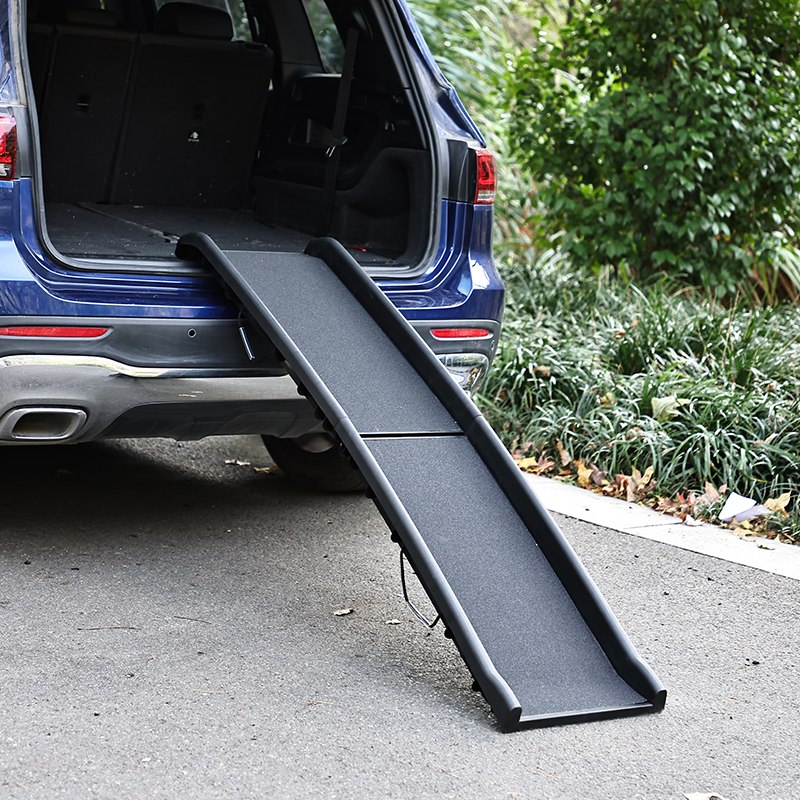
Ramp length has a direct relationship with the distance a dog travels between the ground and the vehicle. When the entry point is high, a shorter ramp creates a sharper incline. A longer ramp spreads the change in height over a greater walking distance, creating a gentler route.
This difference can be noticeable during both ascent and descent. A dog that is comfortable walking on a gradual surface may hesitate when the incline becomes more pronounced. Going down can feel different because the dog has to control its movement while looking toward the ground.
When considering ramp length, several factors should be viewed together:
A longer ramp is not automatically appropriate in every situation. It needs enough surrounding space to rest securely without obstructing nearby areas. The useful question is whether its length creates a practical walking route for both the vehicle and the dog.
Width addresses a different part of the walking experience. A dog does not move along a ramp as a perfectly centered object. It shifts its paws, adjusts its body, and may look toward the sides while climbing. Larger dogs naturally occupy more space, so the usable walking area deserves attention.
A narrow surface may cause some dogs to move cautiously, particularly when they are unfamiliar with ramps. Side edges can also influence confidence. If a dog repeatedly looks down or places its paws close to an edge, additional walking space may make the route feel more natural.
Width should be considered together with length rather than in isolation.
| Ramp characteristic | What it affects | Why it matters |
|---|---|---|
| Narrow walking surface | Lateral movement | May feel restrictive to larger dogs |
| Wider walking surface | Freedom of movement | Allows more room for natural steps |
| Long and narrow design | Walking distance and lateral space | Requires consideration of both dimensions |
| Short and wide design | Walking space and incline | May still create a sharper climb |
For vehicles used by dogs of different sizes, the usable walking surface may need to accommodate the larger animal without making the ramp difficult to position.
A Heavy-duty Pet Ramp should therefore be assessed by its actual walking area rather than its overall appearance.
Weight capacity and stability are related, but they are not the same thing. A structure may be designed to carry a substantial load while still moving if its contact points are poorly positioned or if the supporting surfaces provide insufficient grip.
Stability begins with how the ramp transfers the dog's weight toward the ground and the vehicle. As the dog moves from one section to another, the load shifts. The structure needs to remain settled during this movement rather than responding with unnecessary movement.
Several structural aspects can affect this behavior:
This distinction is useful when comparing different designs. Instead of focusing only on a load rating, it is more practical to consider how the complete structure behaves when a dog actually walks across it.
A Heavy-duty Pet Ramp intended for regular vehicle access should therefore be viewed as a complete system rather than simply a frame with a stated load capacity.
Once a ramp is placed on a vehicle, its stability depends on both the vehicle and the ground. The upper end needs to remain properly positioned, while the lower end needs to stay settled as the dog moves.
The connection point at the vehicle deserves particular attention. Tailgates, cargo edges, and other entry surfaces can differ in shape and material. A ramp that rests securely in one position may require a different placement when the contact area changes.
The lower end is equally important. Smooth ground, loose surfaces, or uneven areas can change how the ramp sits. Contact feet or other support features can help reduce movement, but their performance depends on the surface beneath them.
Before use, several simple checks can help:
A Heavy-duty Pet Ramp may have a sturdy structure, but practical stability still depends on how it is positioned.
The dog's paws are the direct point of contact with the ramp, so the walking surface plays an important role. A smooth surface may provide less traction when paws or the ramp itself become damp. A textured surface can provide additional contact between the paw and the walking area.
The effect becomes more noticeable as the incline increases. During an upward climb, the dog needs enough grip to push against the surface. During descent, it needs to control its movement rather than sliding forward.
The surface also influences familiarity. Some dogs hesitate when they encounter an unfamiliar texture. Allowing a dog to approach the ramp gradually can help it become accustomed to the surface before it is used with a vehicle.
Cleaning is another practical consideration. Dirt and moisture can change the way a walking surface feels under the paws. A surface that is easy to inspect and maintain can therefore be useful for repeated vehicle access.
The key factors include:
These elements work together rather than functioning as isolated features.
Age can change the way a dog approaches vehicle access. A dog that once jumped into a vehicle without hesitation may later prefer a walking route. The difference is not necessarily about whether the dog can climb, but about how comfortably it can change position and manage the movement.
A gradual incline can reduce the need for a sudden jump or sharp body movement. A longer ramp can create that type of route when sufficient space is available around the vehicle.
However, length alone does not solve every issue. A senior dog may also need:
Some dogs may initially hesitate because of the ramp's movement, texture, or height. Introducing it in a calm setting and allowing the dog to approach at its own pace can make the transition more manageable.
In this context, the value of a Heavy-duty Pet Ramp comes from how its different design elements work together with the dog's movement rather than from its structural strength alone.
Vehicle ramps often need to move between storage and use. This creates a practical design question: how can a substantial structure remain manageable when it is not being used?
Folding changes the shape of the ramp for storage, but the hinge sections become part of the overall design. These areas need to operate properly when the ramp is opened and remain aligned during use. The folded shape also determines where the ramp can be placed inside a vehicle.
For regular users, handling can matter almost as much as the walking surface. A ramp that is difficult to position may become inconvenient in everyday use even when its dimensions are suitable.
Several practical considerations can influence portability:
There is also a balance between structural support and portability. A ramp intended for larger dogs may require a substantial frame, while frequent vehicle use calls for manageable handling. The appropriate arrangement depends on how often it is moved and where it is stored.
Vehicle type changes the conditions under which a ramp is used. An SUV, pickup truck, and lower vehicle can present different entry heights, ground clearances, and available space. The same ramp may therefore behave differently from one setting to another.
For a higher vehicle, ramp length becomes an important consideration because it influences the climbing angle. For a lower entry point, a shorter design may be easier to position. Width still needs to match the dog, while the walking surface should provide suitable contact under the conditions in which the ramp will be used.
Storage requirements can also vary. A ramp kept inside a vehicle between uses needs to fit the available space without interfering with other equipment or belongings. A ramp used occasionally may have different handling requirements from one that is positioned frequently.
A practical comparison can focus on the relationship between the vehicle and the ramp:
| Vehicle condition | Ramp consideration | Main point to check |
|---|---|---|
| Higher entry point | Ramp length | Walking angle |
| Limited ground space | Overall ramp dimensions | Placement area |
| Larger dog | Walking width | Available foot space |
| Frequent vehicle use | Folding design | Storage and handling |
| Uneven ground | Support points | Contact with the surface |
| Damp conditions | Surface texture | Paw grip |
Rather than judging a Heavy-duty Pet Ramp by one feature, the selection process can consider the complete setting: vehicle height, available ground space, dog size, movement, surface conditions, support points, and storage.
This approach also explains why ramp design is not simply a matter of choosing a stronger structure. Vehicle access involves several connected conditions, and each one can influence how the dog moves between the ground and the vehicle.



 English
 русский
 عربى
عربى