
AI training clusters do not draw power in a straight line. They spike. For the backup power system sitting behind them, that means short, sharp, high-power discharges, racks packed wall to wall, and zero tolerance for downtime. On September 30, Shoto launched its answer at Data Centre World Asia: the DP60 high-rate lithium battery system, designed specifically for AI data center (AIDC) backup power.
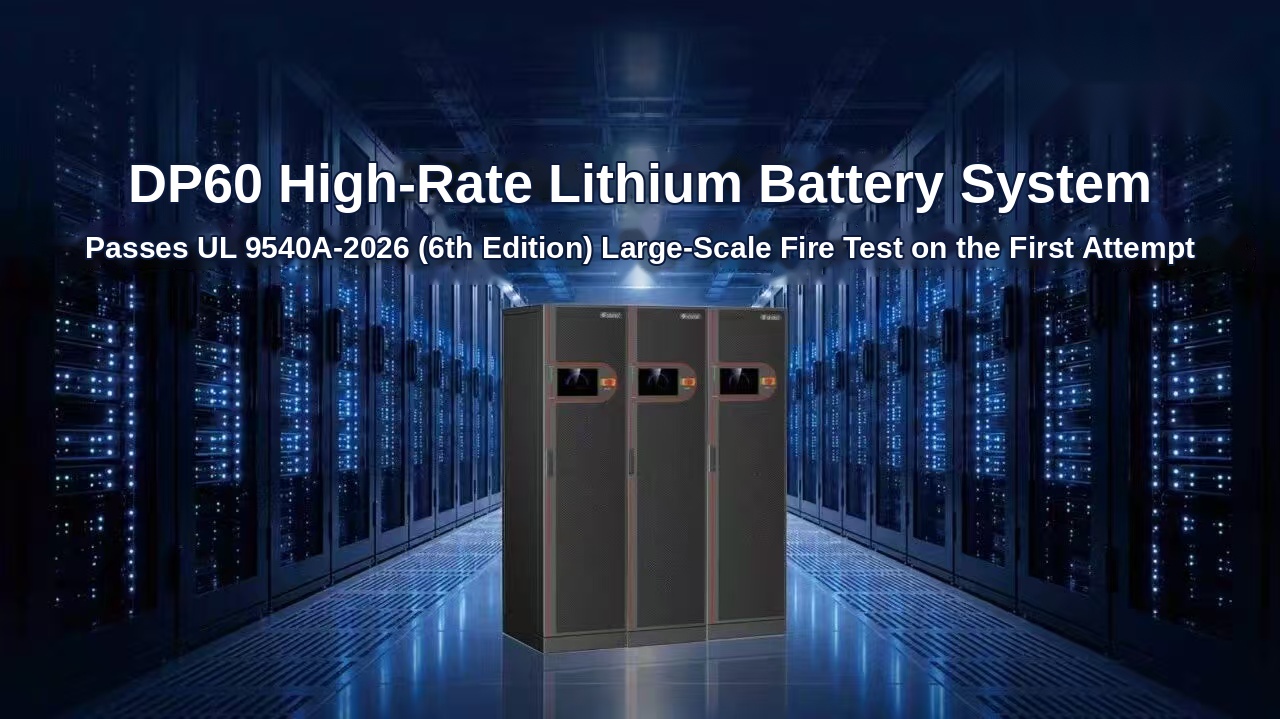
The DP60 is a high-rate lithium battery system for AIDC backup power and energy storage. It is built around three priorities: surviving the worst-case fire scenario, delivering a lot of power from very little floor space, and keeping the system simple enough to run reliably for years.
| Parameter | DP60 |
|---|---|
| Discharge rate | Up to 10C |
| Response to load spikes | Millisecond-level |
| Footprint per cabinet | 0.48 m² |
| Maximum output power | Up to 630 kW |
| Power density | 1,312.5 kW/m² |
| Safety validation | UL 9540A-2026 (6th Edition) large-scale fire test, passed on the first attempt |
Instead of an idealized lab setup, the DP60 was tested to reproduce a real AIDC room at 1:1 scale:
The full cell thermal runaway process was reproduced. The result: thermal runaway and open flame stayed inside the single cabinet. There was no cross-cabinet fire spread, no explosion hazard, no high-voltage arcing, and no re-ignition after the test. Every assessment criterion was passed in a single run.
10C discharge for power peaks. Large-model training creates pulsed, high-power loads. The DP60 responds within milliseconds, absorbing instantaneous surges so compute clusters stay online when load swings sharply.
High power density for valuable floor space. At 0.48 m² per cabinet and up to 630 kW, the DP60 reaches 1,312.5 kW/m². Less area for backup power means more room for racks that earn revenue, and lower infrastructure investment per megawatt of compute.
Simplified circuit design for long-term stability. The system uses large-capacity, ultra-high-rate single cells with streamlined series-parallel connections. Fewer electrical connection points mean a lower chance of failure, easier on-site integration, and simpler maintenance over the equipment's life.
At the exhibition, the Shoto team met overseas customers, design institutes and system integrators. Discussions focused on global safety and compliance standards for AI data centers, adapting overseas projects to local requirements, and optimizing compute-storage architecture. Shoto's position is simple: validate products under extreme real-world conditions first, then talk about them.
It provides high-power backup and energy storage for AI data centers, where compute loads produce sharp power spikes.
Yes. It passed the large-scale fire test under UL 9540A-2026 (6th Edition) on the first attempt, with fire contained within a single cabinet.
Up to 630 kW from a 0.48 m² footprint, a power density of 1,312.5 kW/m².
Looking for AIDC backup power for your project? Contact the Shoto team to discuss your requirements.



 English
 русский
 عربى
